

Knight of the Immaculata (Studies in the Martyr of Charity)
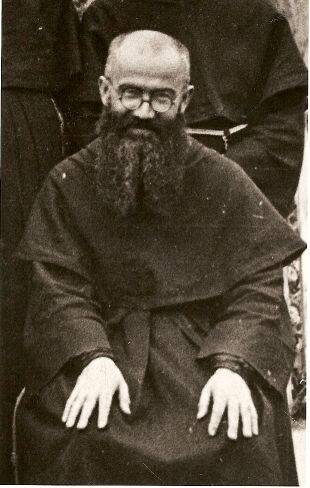


In this section of the blog, I will meditate upon the life of St. Maximilian Kolbe (8 January 1894 – 14 August 1941) by going over his two volumes of writings as published by the Militia Immaculata.
In particular, I provide a series of commentaries to those writings that connects the material of his literary biography thematically, chronologically, and liturgically for purposes of prayerful recollection.
Kolbe was not an academic. He did not write long treatises, or give elaborate oratory in the pulpit, but he was a publicist of a sort, and a man on a mission from God.
Each of those published letters or articles that he wrote reveal his active pursuit of his ideal--- service both to the Mother of God and Mother Church--- and I will try my best to commemorate his words, deeds, and ambitions quite faithfully as they lead up to his imprisonment and heroic self-sacrifice in a Nazi death camp. A major theme of these reflections is that Kolbe's joyful martyrdom was prefigured by his little crosses that emerged in his day-to-day ministries many years before his own death.
To put his life in wider context of the "communion of the saints" (of which he is a recently added member and devoted son of St. Francis of Assisi), I place these writings alongside the Roman Martyrology and the Liturgical Sanctoral Cycle of the Divine Office and ask what the Gospel really demands of us.
Not everyone is called to martyrdom per se, or to accompany Christ quite directly in his walk to Calvary, but we are all called to be ready and willing to pick up our daily Crosses and to do so with a kind of spiritual joy unknown to the world and its received wisdom about the "good life."
As St. Philip Neri (the "the Joyful Saint") who is the other patron saint of this blog (in addition to St. Joseph the Worker) once commented, “to preserve our cheerfulness amid sicknesses and troubles, is a sign of a right and good spirit." For his part, St. Philip was known as the "Joyful Saint" also struggled with anger throughout his life and commentary on his Vita demonstrates that he could experience violent outbursts from time to time which he tried with all of his life of prayer and discipline to contain. But, as God would have it, St. Philip Neri is remembered for his joyfulness not so much his hot temper. In such a dichotomy, there is hope for us all, no?
To courageously be joyful amid difficulty and persecution does seem like a tall order, but if we look at the lives of the saints as we are wont to do, we realize that their diversity of background, walks of life, vocations, and even encounters with Christ is indeed diverse but their shared humanity, culminating in Christ's own Sacred Humanity, does contain an underlying common factor that we shall soon explore.
In Kolbe's "Rule of Life", he led each day with the sentence "I must be a saint and a great saint."
Et sic, erat.
So what kind of person do you wish to be?
___________________________________________________________________________________________________