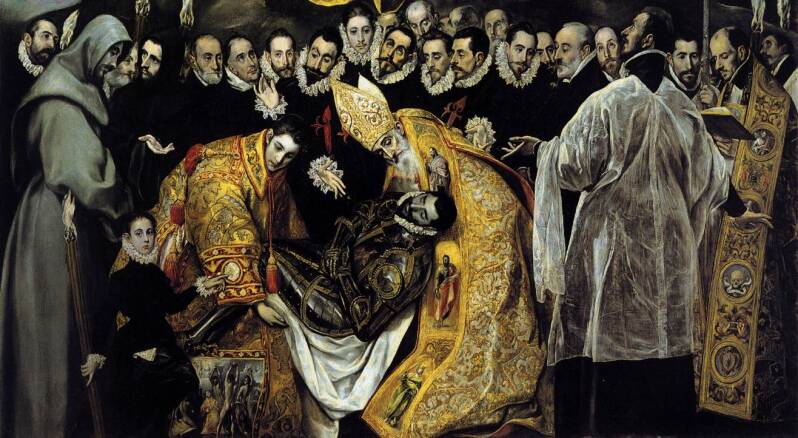
A Worthier Inheritance: Genealogies, Histories, & the Holy Dead
The dead have no other voice; their limbs are stiff, their tongues silent, but the gods demand that those who lived shall speak for them..."
— Sophocles, Antigone
At first glance, exploring death might appear to be a monotonous, melancholic pursuit. Yet, in this space, we uncover the vibrant fruit born from the art of dying well (ars moriendi), which the dead alone can teach.
Our journey spans across:
-
Genealogy & Parish Histories: Unearthing the tales of our ancestry.
-
Funerary Rites & Epitaphs: Resting upon the certainty of ancient observances of filial piety.
-
Communal Devotions: Examining memorials, historical writing, eulogies, purgatorial devotions, the rites of Extreme Unction, and historic confraternity life in addition to the Office of the Dead and its spiritual richness amid mourning.
By contrasting the rich, place-making force of traditional cemeteries with the hushed tone whispers of the modern funerary industry—which often rejects both Christ and the Resurrection—we reveal how the treatment of our dead both in word and deed shapes the prospect of community.
Reclaiming History from Modern Politics
Our mission goes far beyond merely defending a public awareness of the dead. We actively commemorate them, honoring both their triumphs and their tragedies.
We reject the revisionist history of modern identity politics and its fanciful 'moral arc' of history. By contrast, we accept the genuine epoch-turning of the Incarnation, of the God-Man, His life, death, and resurrection as the only true pivot in all of time. All other lives are thus said to conform to this event or they do not.
A Landmark of Ultimate Inclusion
"Pale death beats with equal foot at the pale gates of poor men's huts and at the palaces of kings." — Horace
Death is said to be the only true democrat (lower case "d") who takes equality seriously. Late liberalism’s political radicalism has ironically sparked a communitarian renaissance centered squarely on ancestry, inheritance, and descent because we have come to see as loathsome the desecration of those who cannot defend themselves.
Ultimately, this blog succeeds or fails to the extent that ordinary people begin to see death not as a taboo (a modern horror!), but as a landmark of common destiny—a promise to all people that affords a true sense of home to each and all. Without this finality, such home and placemaking are not possible.
"It is not Death that will come to fetch me, it is the good God. Death is no phantom, no horrible specter... In the catechism it is stated that death is the separation of soul and body, that is all! Well, I am not afraid of a separation which will unite me to the good God forever."
— St. Thérèse of Lisieux
"We also pray for those who are asleep, of whom we also make commemoration. Sanctify these souls, for thou knowest them all. Sanctify those who have died in the Lord, number them among thy holy principalities and grant them a place and a dwelling in thy kingdom!"
— The Anaphora of Serapion (4th Century)
For these enduring reasons, we choose to:
-
Pray for the dead.
-
Learn from the dead.
-
Curate their legacies.
Requiem æternam dona eis, Domine, et lux perpetua luceat eis. Requiescant in pace. Amen.