The Christological Basis of Marian Dogmas & Titles
Traditionally, the Church has taught that Mary is to be given hyper-dulia, a kind of reverence somewhere between the dulia, or "honor", given towards ordinary saints, or holy mortals, and the latria (or sacrificial worship) given only to the Trinity.
In the modern vernaculars, "worship" is strictly confined to mean latria (even if liturgical languages of ancient provenance have a more hierarchical, graded, and complex understanding of "worship" as reflected in the older British English forms of address to judges and other civil authorities: i.e. "your worship".)
Now, this third and poorly understood category of reverence ("hyperdulia") is rather unique, I would argue, (indeed, it only applies to Mary), but this section of the blog argues for the theological (and ontological) distinctiveness of the Virgin Mary in this middle position between the Communion of the Saints (above which she stands as Queen Mother; John 19:26, 1 Kings 2:20, Revelation 12:1, etc.) and the Triune God beneath which she holds a complex and mystical relationship of unparalleled intimacy.
This ontological reality--- being conceived without original sin (and yet as human as we are)--- means that Mary has a special relationship to each of us and to the Church which secures the relationship with Her Son, Her mystical Groom (the Holy Spirit), and ultimately to God the Father (Our Creator).
Here, we explore through both Scripture and Tradition what it means to pursue Jesus through Mary both in the natural/prosaic sense (such as her being a "model disciple") and the deeper supernatural/mystical sense that builds off that prosaic sense.
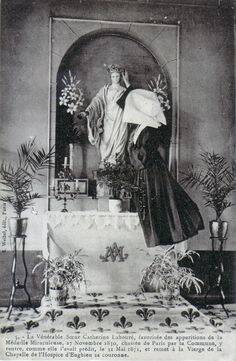
As a bridge between the two senses, we consider the history of Marian Dogma and the forces prompting their articulation in Church History. We also give ground here to examine her Church-approved apparitions and the miracles attributed to her many interventions through particular saints who served her (e.g. Sts. Catherine Laboure, Bernadette Soubirous, Juan Diego, and many others).
Sub tuum præsidium, O Immaculata!